
Introduction
Ask any refrigeration tech what makes or breaks a walk-in cooler, and insulation tops the list every time. It's the single biggest factor in energy efficiency, temperature stability, and how long the unit lasts before major repairs start piling up.
Get it wrong, and the fallout is expensive: spiking utility bills, compressors that run nonstop trying to keep up, and inventory losses when temperatures drift outside safe zones. For restaurants, grocers, and warehouses running on thin margins, that's not a small problem.
This guide breaks down the insulation materials, R-value requirements, panel construction, and floor options that actually matter when you're specifying or replacing a walk-in system.
Key Takeaways
- Polyurethane foam leads factory-built panels for its high R-value and moisture resistance
- Freezers need much higher R-values than coolers, with federal rules mandating an R-28 floor minimum
- Panel edge design, door seals, and floor type all shape real-world insulation performance
- ELT Custom Coolers delivers NSF, UL, and DOE 2017-compliant components built to last
Why Proper Insulation Matters: Energy Efficiency, R-Value & Performance
R-value measures resistance to heat flow. The higher the number, the harder it is for heat to pass through a panel, and the less your compressor has to work to hold temperature. It's calculated from the insulation's K-factor and thickness, tested under standardized lab conditions rather than guessed at.
When insulation underperforms, whether from age, moisture intrusion, or a cheap original build, the effects show up fast:
- Utility bills climb as compressors run longer cycles to offset heat gain
- Compressors wear out faster, since constant overwork shortens equipment life
- Temperatures fluctuate, putting food safety and shelf life at risk
- Frost and condensation appear as moisture works its way into compromised panels
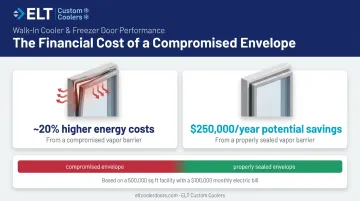
The scale of the problem is bigger than most operators expect. According to IIAR's analysis of refrigerated-facility energy loss, compromised vapor barriers and air infiltration can drive energy costs up by nearly 20%.
In a modeled 500,000-square-foot facility with a $100,000 monthly electric bill, sealing the envelope properly could save close to $250,000 a year. That's not a rounding error.
Recommended R-Values for Walk-In Coolers vs. Freezers
Coolers and freezers don't need the same thermal protection, and the difference is significant.
| Component | Cooler minimum | Freezer minimum |
|---|---|---|
| Walls, ceilings, doors | R-25 | R-32 |
| Floor | Not federally mandated (situational) | R-28 |
| Typical panel thickness | 4 inches | 4-6 inches |
These aren't arbitrary numbers. The DOE's 2017 energy conservation standards set R-25 as the prescriptive minimum for cooler enclosures and R-32 for freezers, with freezer floors held to R-28 regardless of location. The rule took effect in September 2017 and remains the benchmark most manufacturers build against today.
ELT Custom Coolers' prehung cooler and freezer doors are manufactured to meet or exceed these R-25/R-32 minimums, so swapping in a replacement door keeps the box compliant without any extra engineering.
Panel thickness and R-value aren't the same thing, though they're related. A thicker panel generally allows for a higher R-value, but the foam formulation and how it's bonded to the metal skins matter just as much as raw inches.
Best Insulation Materials for Walk-In Coolers and Freezers
Polyurethane foam dominates the commercial walk-in market for good reason. Its 97% closed-cell structure traps gas bubbles that resist heat transfer far better than open-cell alternatives, and it bonds permanently to the metal panel skins during manufacturing rather than sitting as a loose-fit board.
That bond matters more than it sounds. A permanently adhered foam core adds structural rigidity to the panel and eliminates the air gaps that let heat sneak through over time.
Polyurethane's other advantages:
- Delivers roughly R-6 to R-8 per inch in fresh condition, more than most alternatives
- Uses low global-warming-potential blowing agents that meet EPA and CARB guidelines
- Carries a UL Class 1 fire rating in most commercial formulations, with flame spread ratings well under industry thresholds
Polystyrene (EPS/XPS) is the budget alternative, and it has a place in some builds. It costs less upfront, but delivers a lower R-value per inch than polyurethane.
It's typically installed as a preformed board rather than foamed in place, and that construction method tends to leave seams that are less airtight, especially at hard rail panel edges where the board meets the frame.
ELT Custom Coolers builds its replacement doors around R-20 to R-32 closed-cell insulation cores depending on application, and its 8'x8'x8' turnkey walk-in box uses an R-32 polyurethane freezer-grade core with 4-inch wall and ceiling panels. Every component carries NSF approval, UL certification, and DOE 2017 compliance.
Spray Foam & Injection Foam for Retrofits
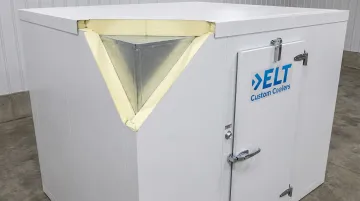
Spray foam and injection foam serve a different purpose than factory panels. They're built for retrofitting an existing enclosed room or renovating exposed walls, not for new prefabricated builds.
- Open-cell spray foam works on exposed interior walls without moisture exposure
- Closed-cell spray foam adds density and moisture resistance for structural applications
- Injection foam gets pumped into enclosed cavities to fill gaps without tearing walls open
For most operators dealing with an aging enclosure, though, the door is where heat loss actually concentrates, not the wall cavity. That's where a targeted door and frame replacement, rather than a full retrofit foam job, often solves the problem more directly.
Panel Insulation: Walls, Ceilings & Doors
Panel edges come in two designs, and the difference affects how tight the seal stays over years of use.
Soft nose construction uses the same polyurethane foam at the edge as the core, paired with flexible gaskets that maximize foam-to-foam contact. Hard rail (or hard nose) designs use wood or high-density perimeter rails for edge structure, which interrupts the foam core and shifts sealing responsibility to the rail-gasket interface.
Soft nose panels generally hold a tighter, more energy-efficient seal over time because there's no rigid material to shrink, warp, or separate from the foam.
Doors deserve special attention because they're the biggest single source of heat infiltration in most walk-ins. Research led by NREL on walk-in door infiltration found that warm, moist air exchange during door openings can account for more than 50% of total cooling load.
With a test door left open, nearly the entire cold-air volume inside exchanged in about two minutes. Leakage through cracks and seals, by comparison, made up only about 1% of that infiltration.
That statistic changes how you should prioritize spending. A slightly higher R-value on the wall panels matters far less than:
- A tight-sealing gasket system
- A functioning door closer
- Traffic discipline that keeps doors from sitting open
ELT's replacement doors address this directly with magnetic door gaskets and double-sweep gaskets standard on every configuration. Freezer models add a replaceable anti-condensate heat wire at the frame to fight frost buildup. Standard panel thickness runs 4 to 6 inches, with freezer applications generally sitting at the higher end to hit R-32 or better.
Floor Insulation Requirements and Options
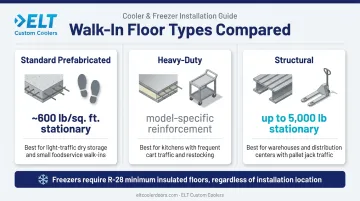
Floor insulation isn't optional for freezers. Federal guidelines require a minimum R-28 insulated floor regardless of geographic location. Coolers are more situational, depending on installation conditions and foot traffic.
When you need an insulated floor:
- Always, for any freezer installation
- Any elevated installation, including second-story builds
- Any unit sitting over a basement, crawlspace, or parking structure
Skipping insulation in these conditions invites condensation, which breeds mold fast. Moisture that migrates through an uninsulated floor over a basement or crawlspace doesn't just waste energy; it can rot structural framing underneath over time.
Floor types and load capacity:
| Floor type | Typical capacity | Best for |
|---|---|---|
| Standard prefabricated | ~600 lb/sq. ft. stationary | Light foot traffic, minimal equipment |
| Heavy-duty | Model-specific reinforcement | Rolling carts, moderate traffic |
| Structural | Up to 5,000 lb stationary | Hand pallet jacks, heavy carts |
Floorless walk-ins exist, but only under narrow conditions: an indoor concrete slab sitting directly on the ground, with nothing beneath it. No basement, no crawlspace, no exceptions. The moment you're dealing with a freezer or an elevated space, an insulated floor is part of the build.
Signs of Insulation Failure & Choosing a Trusted Manufacturer
Signs of Insulation Failure
Insulation doesn't fail overnight. It shows warning signs first, and catching them early saves you from a much bigger repair bill later.
Watch for these red flags:
- Frost buildup on walls, ceilings, or around door frames
- Visible condensation or water pooling near panel seams
- Energy bills that creep up without a clear cause
- Internal temperatures that swing instead of holding steady
- Panels that feel damp or heavier than usual after warming to room temperature
A quick seasonal walkthrough catches most of these issues before they turn into compressor failure or spoiled product:
- Check gaskets for wear
- Confirm the door closer engages fully
- Look for frost at panel joints
Choosing a Trusted Manufacturer
When it's time to replace panels, doors, or an entire unit, the manufacturer you choose matters as much as the material. ELT Custom Coolers has spent over 18 years as an American, family-owned manufacturer building NSF-approved, UL-certified, DOE 2017-compliant doors, frames, and turnkey walk-in boxes. That track record counts for something when you're trying to avoid a repeat insulation failure five years down the road.
If you're planning new construction, a retrofit, or a straightforward panel replacement, talk to a specialist before you buy. The right insulation solution depends on your specific application — get expert input before you commit to a single option.
Frequently Asked Questions
What is the best insulation for a walk-in cooler?
Polyurethane foam is the top choice thanks to its high R-value per inch, strong moisture resistance, and permanent bond to metal panel skins. It also creates tighter, more airtight seams than polystyrene alternatives.
What R-value does a walk-in cooler need?
Coolers typically need R-25 to R-30, while freezers require R-32 or higher. These figures align with DOE 2017 compliance standards for walk-in enclosures.
How thick should walk-in cooler insulation be?
Standard panel thickness runs 4 to 6 inches, with thickness tied to application: coolers often use 4-inch panels, while freezers may need 5 or 6 inches to hit required R-values.
Can you insulate an existing walk-in cooler without replacing the panels?
Yes, injection foam can fill gaps in enclosed wall cavities without demolition. However, if panels show significant moisture damage or frost saturation, full replacement is usually the more reliable fix.
How often should walk-in cooler insulation be inspected or replaced?
A seasonal visual inspection catches most early warning signs, including frost, condensation, or gasket wear. Replace insulation or affected components as soon as those signs appear rather than waiting for a full failure.
Does insulation quality affect walk-in cooler energy costs?
Yes. Higher R-value insulation reduces how hard the compressor has to work, which directly lowers long-term electricity costs. Poor insulation forces constant overcycling and drives utility bills up over time.