Introduction
Search "walk-in cooler box without refrigeration" and you'll find a confusing mix of listings. Some show complete units. Others show empty insulated shells. The difference matters more than most buyers realize.
A walk-in cooler "box" is the insulated structure alone: walls, ceiling, floor, and door. It's sold separately from the compressor, condenser, and evaporator that actually make it cold.
Many restaurant owners and facility managers don't know this split purchase even exists. That gap leads to two expensive mistakes: paying for a refrigeration system you don't need, or buying a box that doesn't match the compressor you already own.
This guide covers what a box-only walk-in cooler actually is and why so many businesses choose this route. It also breaks down the specs that matter before you buy and how to pair the enclosure with the right refrigeration equipment.
Key Takeaways
- A walk-in cooler "box" is the insulated enclosure only — no compressor, condenser, or evaporator attached.
- Businesses go box-only to reuse refrigeration, phase project costs, or fit tight spaces.
- Insulation R-value, panel material, door type, and flooring drive both performance and price.
- NSF, UL, and DOE 2017 compliance apply to the box and door, regardless of refrigeration system.
What Is a Walk-In Cooler Box Without Refrigeration?
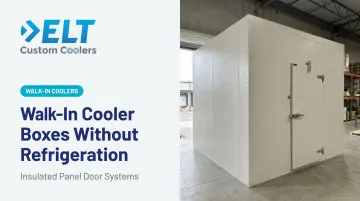
A box-only walk-in cooler is a prefabricated or custom-built insulated enclosure made from foam-core panels, designed to hold cold air once refrigeration is connected. It ships without a compressor, condensing unit, or evaporator coil.
Buyers in the commercial refrigeration market typically encounter three purchasing paths:
| Option | What's included | Best for |
|---|---|---|
| Box only | Panels, door, hardware | Reusing an existing compressor or sourcing refrigeration separately |
| Box + refrigeration package | Enclosure plus a selected condensing unit, priced together | Buyers who want choice but prefer one invoice |
| Turnkey walk-in cooler | Fully matched box and refrigeration, ready to install | First-time buyers who want simplicity |
Construction and Materials
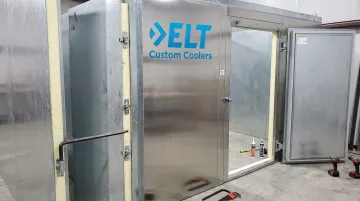
Whichever path buyers choose, the enclosure follows similar construction standards. Most box-only enclosures use polyurethane or polystyrene foam-core panels with galvanized steel or stainless steel skins, typically 3 to 6 inches thick depending on cooler or freezer rating. Panels connect using cam-lock hardware, letting crews assemble a full room on-site without welding or specialized tools. The door and its hardware handle most of the wear on an otherwise static shell, which is why suppliers like ELT Custom Coolers build prehung doors and cam-rise hinges specifically to match these enclosures.
"Without refrigeration" does not mean uninsulated. The box still holds temperature once cooling is attached; it just doesn't generate that cold air on its own.
Where Box-Only Setups Show Up
These construction standards show up in a handful of common real-world scenarios:
- Replacing a damaged compressor while keeping a structurally sound box
- Building a custom enclosure to pair with a separately purchased self-contained or remote system
- Expanding cold storage in phases as budget allows
- Relocating a business and reusing existing refrigeration equipment
Panels typically ship flat-packed. That's why box-only purchasing appeals to businesses with irregular kitchen layouts or basement access points that a standard prefab unit can't reach.
Why Businesses Choose Box-Only Walk-In Coolers
Buying the enclosure separately is a deliberate move tied to cost, equipment ownership, or space constraints, not a shortcut.
Cost Control and Phased Budgeting
When a business already owns a working compressor, paying again for a bundled refrigeration system makes no sense. Box-only purchasing lets owners:
- Skip paying for refrigeration they already have
- Choose a specific compressor brand, efficiency rating, or noise profile
- Select self-contained or remote systems based on kitchen ventilation and layout
New restaurant builds often follow similar logic, installing the insulated box first and adding refrigeration once financing clears or a build-out phase completes. This spreads capital spend across a construction timeline instead of one large invoice.
Retrofits, Repairs, and Custom Sizing
This is the most common real-world scenario. A compressor fails, or a business relocates and only needs a new insulated shell, and reuses the existing cooling equipment. It's also where door condition matters most, since a worn gasket or warped door frame on an otherwise sound box undermines the whole retrofit.
ELT Custom Coolers builds prehung replacement cooler and freezer doors specifically for this situation, with standard-frame, plug-frame, and heated-frame options that drop into existing rough openings.
Custom sizing follows the same practical logic. Standard all-in-one units rarely fit tight kitchens, converted retail backrooms, or warehouse corners with unusual ceiling heights, so box-only purchasing allows dimensions built around the space instead of forcing the space to fit a fixed package.
Demand for this flexibility is climbing. The global walk-in cooler and freezer market was valued at $11.96 billion in 2025 and is projected to reach $37.27 billion by 2034, according to Fortune Business Insights. That growth reflects more operators customizing equipment rather than defaulting to one fixed package.
Key Specifications & Features to Evaluate
Not every insulated box performs the same. A few specs determine whether your cooler holds temperature efficiently or bleeds cold air (and money) for years.
Insulation and Panel Material
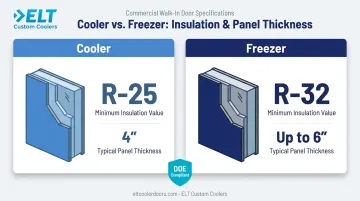
Panel thickness in the current market typically ranges from 4 to 6 inches, though thickness alone doesn't guarantee performance. Federal minimums require R-25 for cooler walls, ceilings, and doors, and R-32 for freezer walls, ceilings, and doors, per the DOE's energy conservation standards.
Polyurethane foam-core panels are the industry standard, generally outperforming older polystyrene panels on insulation value per inch. Manufacturer test data varies, so ask for the assembly's rated R-value, not just panel thickness.
Door Types and Hardware
Door selection affects daily operations as much as insulation does:
- Flush swing doors – standard for most walk-in coolers
- Half doors – useful for pass-through cold storage
- Sliding doors – save floor space in tight aisles
- Frame heaters – prevent frost buildup around freezer openings in cold climates
Hardware quality matters just as much as door style. Cam-rise hinges lift the door slightly on opening, clearing floor debris and improving the seal on close. Look for hydraulic closers, secure latches, and an interior safety release, non-negotiable for any walk-in a person could get trapped inside.
Flooring and Load Capacity
Some boxes include reinforced floor panels rated for freezer loads, typically 150 lbs. per square foot for foot traffic and higher for forklift or pallet-jack use. Others require a separately poured concrete slab with its own vapor barrier and insulation break, which affects both budget and installation timeline.
Diamond-plate or textured non-slip surfaces cut injury risk in wet environments, a common OSHA concern for high-traffic coolers. Confirm the load rating and flooring type before ordering, especially for meat-packing, warehouse, or other high-traffic cold-storage setups.
Certifications That Matter Regardless of Refrigeration Source
The box and door need to meet food safety and energy codes independent of whichever compressor gets attached later. Look for:
- NSF approval for food-contact safety and sanitation
- UL certification for electrical and refrigerant safety
- DOE 2017 compliance for energy efficiency
ELT Custom Coolers' walk-in cooler and freezer doors and panels carry NSF approval, UL certification, and DOE 2017 compliance, meeting code regardless of which refrigeration unit connects to it. With over 18 years building custom coolers, the company also manufactures made-to-order doors for openings that don't match a catalog SKU.
Box-Only vs. Complete Walk-In Cooler System
Both paths get you a working cold room. The difference is who handles the coordination.
| Factor | Box-Only | Complete/Turnkey System |
|---|---|---|
| Refrigeration | Sourced and installed separately | Factory-matched, ready to run |
| Upfront flexibility | High – choose any compatible unit | Low – tied to bundled equipment |
| Technical complexity | Requires proper sizing and licensed installation | Simplified, manufacturer-backed compatibility |
| Best for | Existing equipment reuse, unique specs | First-time buyers wanting straightforward setup |
Box-only offers real savings potential and equipment freedom, but it demands either in-house refrigeration knowledge or a licensed contractor who can size and connect the system correctly. Complete systems trade that flexibility for simplicity: everything arrives matched and warrantied as one unit.
Our recommendation: Choose box-only if you already own compatible refrigeration equipment or have space constraints that a standard unit can't solve. Choose a complete system if this is your first walk-in installation and you want one point of accountability.
Adding & Retrofitting Refrigeration Equipment
Buying the box is only half the project. Getting refrigeration sized and installed correctly determines whether the cooler actually performs.
Matching Capacity to the Box
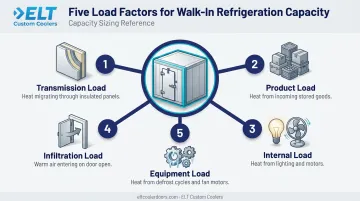
Refrigeration capacity, measured in BTU or horsepower, has to account for more than cubic footage. ASHRAE identifies five load factors that belong in the sizing calculation:
- Transmission through the walls, floor, and ceiling panels
- Product load from items entering above set-point temperature
- Internal loads from lighting, fans, and motors
- Infiltration air from door openings and traffic
- Equipment-related loads from defrost cycles and controls
Skipping any of these risks an undersized system that never holds temperature, or an oversized one that short-cycles and wastes energy.
Self-Contained vs. Remote Systems
| System Type | Installation | Trade-off |
|---|---|---|
| Self-contained | Mounts directly on the box | Rejects condenser heat into the surrounding room |
| Remote condensing | Sits outside the building or on the roof, with refrigerant lines run to the box | Reduces indoor heat and noise, but adds installation coordination |
According to Foodservice Equipment Reports, the right choice depends on available clearance, how fast incoming product needs to cool, and whether removing condenser heat from the kitchen is a priority.
Get the Installation Right
Work with a certified refrigeration technician for electrical connections, refrigerant line sizing, and drainage. Improper installation voids warranties and creates food safety risks that a properly matched box and door can't fix on their own.
Frequently Asked Questions
What is the difference between a walk-in cooler box and a walk-in freezer box?
Freezer boxes require thicker insulation, reinforced flooring, and heated door frames to prevent frost buildup and structural stress from ice. Cooler boxes run above freezing and use standard insulation without those frost-prevention features.
Can I install my own refrigeration system in a walk-in cooler box?
It's technically possible, but proper capacity sizing and licensed installation are critical for food safety, energy efficiency, and warranty compliance. Most manufacturers recommend a certified technician for the electrical and refrigerant connections.
How much does a walk-in cooler box without refrigeration cost?
Pricing depends on panel thickness, door type, exterior finish, and custom dimensions versus standard sizing. Get a specific quote based on your footprint rather than relying on a generic price range.
What size walk-in cooler do I need for my restaurant?
Sizing depends on menu volume, storage needs, and how often deliveries arrive. A cooler specialist can walk through your inventory patterns and recommend accurate dimensions.
What insulation thickness is required for a walk-in cooler box?
Panels commonly run 4 inches for coolers and up to 6 inches for freezers, though the actual R-value rating matters more than raw thickness. Colder climates and freezer applications generally call for higher insulation values.
Do walk-in cooler boxes come with flooring included?
It varies by manufacturer. Some boxes ship with reinforced floor panels built in, while others require a separately poured concrete slab before installation.