
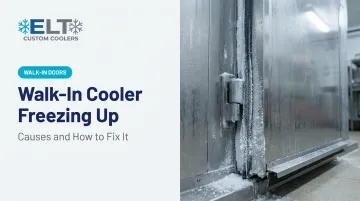
Freeze-ups build gradually, usually from worn door seals, blocked airflow, a stuck defrost cycle, or a slow refrigerant leak. Ignore them long enough and you risk spoiled inventory, a failed health inspection, and a compressor that's straining harder than it should. This guide walks through the common causes, how to diagnose them step by step, when a repair makes sense versus a replacement, and when it's time to call in a certified technician.
Key Takeaways
- Six culprits cause most freeze-ups: gaskets, temperature settings, airflow, defrost timers, refrigerant, and drain lines
- Ice location (door, coil face, suction line, or drain pan) reveals the root cause before you touch a single part
- Gaskets, temperature settings, and stock rearranging are DIY fixes; refrigerant and electrical work need a licensed tech
- Repeated freeze-ups on an aging unit usually signal it's time to replace, not repair again
What Is a Walk-In Cooler and Why Does It Freeze Up?
A walk-in cooler is a large refrigerated room built around a compressor, condenser, and evaporator working together to hold temperatures in a specific range. Most manufacturers, including Norlake, recommend keeping walk-in coolers between 35°F and 38°F — cold enough to slow spoilage without dipping into freezing territory.
Here's where confusion sets in. A thin layer of frost on the evaporator coil is completely normal. It forms between defrost cycles and melts off automatically. Solid ice, on the other hand, is not normal. It means the defrost process isn't keeping up, or something else is pushing the coil below its intended operating temperature.
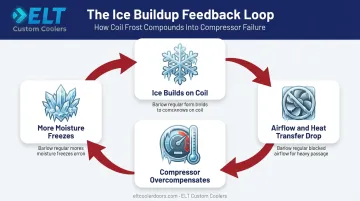
Once ice takes hold, it acts like insulation on the coil. That forces the compressor to run longer and colder to hit the same temperature, which creates more ice. This is a self-reinforcing cycle:
- Ice builds on the coil
- Airflow and heat transfer drop
- The compressor overcompensates by running colder and longer
- More moisture freezes onto the coil
Left unchecked, this loop gets worse every day. The freeze-up itself is never the actual problem. It's always a symptom pointing back to a specific mechanical, electrical, or operational failure elsewhere in the system.
Common Causes of a Walk-In Cooler Freezing Up
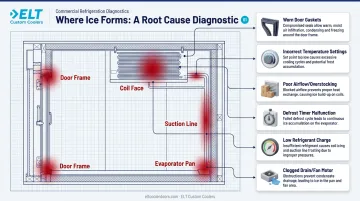
Freeze-ups follow predictable patterns. Once you know where the ice is forming, you're most of the way to a diagnosis.
Damaged or Worn Door Gaskets
Symptoms: Ice near the door frame or hinges, condensation trails on the floor by the entrance.
Cause: A torn or poorly sealing gasket lets warm, humid kitchen air rush in every time the door opens. That extra moisture load freezes onto the coil faster than the system can clear it, making this one of the most fixable freeze-up triggers.
Every ELT Custom Coolers prehung replacement door ships with a two-part sealing system: a magnetic gasket for the primary seal and a double-sweep gasket at the threshold. Replacing a worn seal like this often solves the freeze-up permanently.
Incorrect Temperature Settings
Symptoms: Thermostat set below 35°F; ice spread evenly across the entire coil face.
Cause: Dropping the setpoint unnecessarily low pushes the coil surface below freezing, even when the box temperature reads fine.
Poor Airflow or Overstocking
Symptoms: Ice concentrated right in front of the evaporator fans; warm spots elsewhere in the unit.
Cause: Boxes or product stacked against the coil or fan blades trap cold air at the coil surface instead of letting it circulate.
Defrost Timer or Cycle Malfunction
Symptoms: Compressor runs continuously without cycling off; heavy ice despite clean coils and clear airflow.
Cause: A burned-out defrost timer motor or a failed heater element means frost never gets a chance to melt between cycles. Defrost strategy also affects energy use: one commercial walk-in freezer study found that adaptive defrost used 20.54% less energy than a fixed 4-hour timed defrost schedule. A stuck or poorly tuned timer wastes energy in addition to causing ice buildup.
Low Refrigerant Charge or Failing Expansion Valve
Symptoms: Ice concentrated at one specific point on the coil or suction line, spreading outward; longer-than-normal run times.
Cause: A leak or a stuck expansion valve drops coil pressure and temperature below normal, freezing moisture on contact.
Clogged Condensate Drain Line or Failing Fan Motor
Symptoms: Puddles or a musty smell on the floor, ice climbing up from the bottom of the evaporator pan, or a grinding, slowing fan.
Cause: Debris-clogged drains let defrost water refreeze in the pan, while a dying fan motor stops pulling air across the coil altogether.
How to Fix a Walk-In Cooler That's Freezing Up (Step-by-Step)
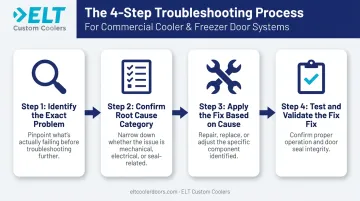
Chipping ice off the coil without finding the trigger wastes time. It typically comes back within days. Work through these steps in order to isolate the true cause before touching or replacing any part.
Step 1: Identify the Exact Problem
- Note precisely where ice is concentrated: door area, coil face, suction line, or evaporator pan
- Check the thermostat against the 35-38°F range
- Listen for a compressor that never cycles off
- Document how long the issue has been happening, and whether it started after a heat wave, a busy shift, or a recent repair
Step 2: Confirm the Root Cause Category
Sort what you found into one of three buckets: airflow/mechanical (gaskets, overstocking, fans), electrical/control (defrost timer, thermostat), or refrigerant-related (leaks, expansion valve).
Before assuming the worst, rule out the obvious first: a door propped open, a tripped breaker, or a kitchen that's simply running hot that day. Don't authorize refrigerant work or a new fan motor until you've confirmed that's actually the cause.
Step 3: Apply the Fix Based on the Cause
This is where the repair path splits, and where most of your time and budget gets decided.
If the Issue Is Airflow or Door-Related
- Reorganize stock to clear the evaporator fans and coil face completely
- Replace torn or poorly sealing gaskets, or upgrade to a properly fitted commercial door if the frame itself has warped
- Check that strip curtains or auto-closers are working to limit warm air infiltration — a Kason 402 strip curtain alone can cut compressor run-time by 20-40% on high-traffic doorways
If the Issue Is Electrical or Defrost-Related
- Manually advance the defrost timer dial. No click, no cycle usually means the timer motor is dead
- Inspect the defrost heater element and sensors for continuity issues
- Recalibrate or replace a malfunctioning thermostat or control board
If the Issue Is Refrigerant or Component-Related
Refrigerant work isn't a DIY project. The EPA requires anyone servicing equipment that could release refrigerant to hold Section 608 certification, and for good reason: improper handling can damage the system or violate federal law.
- A certified technician should leak-search, repair, evacuate, and recharge the system to spec
- If ice consistently starts at one exact point on the valve and spreads outward, the expansion valve likely needs replacing
- Watch for oily residue near fittings or valves, which often signals a slow leak before ice becomes visible
If the Issue Is Environmental or Operational
- Clean the condenser coils and clear algae or debris from the condensate drain line
- Address staff habits around propping doors open or overstocking the coil area
- Improve ventilation or dehumidification in particularly steamy kitchens
Step 4: Test and Validate the Fix
Run the unit through a full cool-down and defrost cycle, watching how quickly temperature recovers. Confirm ice doesn't reform within 24-48 hours of normal operation. Then check door seals and drain flow again a week later to make sure the fix actually held.
Should You Fix or Replace Your Walk-In Cooler?
Weigh the repair cost, the unit's age, and how often the same problem keeps coming back before deciding.
Scenario 1: Isolated Gasket or Airflow Issue on a Unit Under 10 Years Old
Fix: An inexpensive gasket swap or door adjustment usually resolves it outright.
Replace: Only if the door frame itself has warped beyond repair.
Scenario 2: Recurring Freeze-Ups Despite Multiple Repairs on an Aging Unit
Fix: A temporary patch buys time if budget is tight right now.
Replace: A new, well-insulated, DOE-compliant door stops the cycle for good. ELT Custom Coolers builds its replacement doors to NSF standards with a two-gasket seal, plus an anti-condensate heated frame on freezer models that keeps ice from forming around the frame.
Scenario 3: Refrigerant Leak in an Older System Using Outdated Refrigerant
Fix: Acceptable if the leak is minor and refrigerant is still available. Reclaimed R-22 remains legal for servicing existing systems even though new production ended in 2020.
Replace: Recommended if the leak keeps recurring or the refrigerant type is obsolete.
Whatever the scenario, some signs override the fix-or-replace math entirely. If you've tried DIY fixes and the ice keeps coming back, if you're hearing electrical buzzing, or if you smell anything unusual near the compressor, stop troubleshooting and call a certified refrigeration technician right away.
Preventive Maintenance Tips (and Final Thoughts)
Consistent upkeep is cheaper than a walk-in cooler full of spoiled inventory.
Daily:
- Confirm the door closes and latches fully
- Check the temperature gauge against 35-38°F
- Keep stock clear of the evaporator fans
Weekly:
- Inspect door gaskets for tears and wipe them clean
- Sweep debris away from the drain area
Monthly/Quarterly:
- Clean the condenser coils
- Flush the condensate drain line
- Listen for grinding or slowing fan motor noise
Most freeze-ups are preventable, and the ones that do happen are almost always fixable once you know where to look. Getting the diagnosis right the first time saves you from replacing parts that were never the problem. Knowing when to repair versus replace protects both your food safety record and your bottom line. When a gasket or door frame is beyond saving, ELT Custom Coolers supplies prehung replacement doors, gaskets, and Kason-compatible hardware sized to fit your existing opening, including heated-frame options for freezer units.
Frequently Asked Questions
Why is my walk-in cooler freezing over?
It's typically caused by blocked airflow, worn door seals, an incorrect temperature setting, a failed defrost timer, or low refrigerant, not the unit working too well. Pinpointing where the ice sits tells you which of these is at fault.
How often should you defrost a walk-in cooler?
Modern coolers run automatic defrost cycles several times a day without any manual input. To test the cycle manually, advance the defrost timer dial by hand and listen for a click that triggers the heater.
What is the life expectancy of a walk-in cooler?
Most manufacturers cite an average service life of around 15 years, though that depends heavily on gasket condition, panel insulation, and how often the coils get cleaned. Many operators start weighing replacement after year 10.
Can I keep operating a walk-in cooler while it's icing up?
You can, but you shouldn't for long. Continued operation risks inventory spoilage, food safety violations, and added strain on a compressor that's already working overtime. Address the cause as soon as you spot it.
How much does it typically cost to repair a walk-in cooler freeze-up?
Costs vary widely depending on the cause — a gasket swap is far cheaper than a refrigerant recharge or defrost control replacement. Get a diagnosis first so you're not paying for guesswork.
Will replacing the door gasket alone fix a freezing problem?
It will resolve airflow and humidity-related freeze-ups, but it won't fix a bad defrost timer, low refrigerant, or a failing fan motor. Proper diagnosis before you buy parts is still the fastest path to a lasting fix.