
Introduction
In August 2020, an employee became trapped inside a walk-in refrigerator, developed hypothermia, and died before help arrived. OSHA's own accident record confirms it: a failed door release turned a routine cold-storage task into a fatality.
This kind of failure is entirely preventable. It happens when interior safety hardware gets treated as an afterthought.
For commercial operators, the fallout from a walk-in freezer incident reaches well beyond the tragedy itself: lost workdays, OSHA citations, rising insurance premiums, and spoiled inventory when a unit fails mid-shift. A single citation for an inoperable door release can trigger an investigation that disrupts operations for days.
Here's the good news. Walk-in freezers rank among the most manageable risks in a commercial kitchen or cold-storage facility, provided the equipment is built to code and the safety systems (locks, alarms, PPE) actually get used. This guide breaks down exactly what that looks like.
Key Takeaways
- OSHA 1910.36 requires interior emergency releases, tested regularly to prevent entrapment
- Cold stress, frostbite, and hypothermia are real hazards requiring PPE and limited exposure time
- Proper clearances, electrical isolation, and factory-installed safety hardware at installation prevent long-term hazards
- Dry ice CO2 buildup, condensation, and icy flooring are ongoing risks, not one-time concerns
- Routine inspections, alarm checks, and refresher training keep safety systems functional over time
Safety Guidelines for Walk-In Freezers
Staying safe in and around a walk-in freezer comes down to three overlapping categories: mechanical systems (door locks and releases), environmental exposure (extreme cold, ice, CO2), and behavioral discipline (shortcuts, lone working). Miss any one of these, and the other two won't cover for it.
None of it works in isolation. A perfectly maintained door release doesn't help if nobody ever tests it, and a well-trained crew can't compensate for a unit that shipped without NSF- or UL-rated safety hardware.
Safety in a walk-in freezer works as a daily operational habit, not a one-time box checked off during installation. It depends on certified equipment paired with consistent maintenance discipline.
General Safety Precautions
Cold exposure starts faster than most staff expect, which makes PPE non-negotiable, even for "quick" trips.
PPE for freezer entry should include:
- An insulated jacket rated for sub-zero work, not just a fleece pullover
- Insulated gloves that still allow enough grip for lifting boxes
- Headgear covering the ears, since heat loss through the head accelerates cold stress
- Thermal base layers under standard uniforms for extended stocking tasks
- Insulated, non-slip footwear rated for wet, icy flooring
Workspace readiness matters just as much as what staff wear. Wet floors, ice patches, and cluttered aisles cause more freezer injuries than the cold itself does. Keep floors dry, add non-slip mats near entry points, and keep pathways clear of stray pallets.
Handling basics reduce strain injuries, too:
- Bend at the knees when lifting, not the back
- Use wheeled carts only on flooring rated for wheel traffic
- Never overload shelving beyond its rated capacity
The "check before you lock" rule is non-negotiable. Before securing any walk-in unit, confirm nobody is inside. A simple entry log or buddy system, where a second staff member logs entry and exit times, closes this gap at no real cost.
Finally, build a daily pre-shift habit: test the interior emergency release before the first delivery of the day. Frozen or sticky releases are common in freezer units and often go unnoticed until someone actually needs one.
Safety During Installation
Installation mistakes create hazards that follow a unit for its entire service life. Getting this stage right the first time avoids expensive retrofits later.
Site preparation starts with clearance. Manufacturer specs call for adequate space from walls and ceiling, not just for door swing, but for airflow around the compressor. Crowd a condensing unit against a wall, and expect shorter compressor life and inconsistent internal temperatures.
Electrical isolation during setup or repair follows OSHA's lockout/tagout standard (1910.147). That means:
- Identifying the energy source and shutting it down through established procedures
- Applying lockout or tagout devices to every isolating device
- Verifying a zero-energy state before any technician begins work
- Confirming employees are clear before reenergizing the system
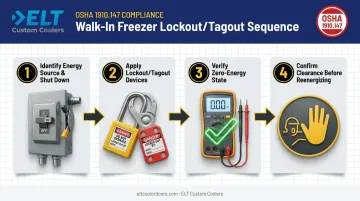
Skipping this sequence is one of the most commonly cited violations in commercial refrigeration work.
The biggest installation-stage decision, though, is sourcing. A unit should never go into service without a factory-installed interior safety release, tested panic hardware, and working emergency lighting already in place. Retrofitting these features afterward is possible, but costly, and it leaves gaps in the meantime.
This is where sourcing NSF-approved, UL Certified doors pays off. ELT Custom Coolers builds its prehung cooler and freezer doors with the lockable latch and interior safety release handle installed at the factory in Detroit, alongside Chrome NSF-approved hardware. Operators aren't relying on a contractor to source and mount safety-critical components after the unit arrives.
Safety While Using or Operating
Most walk-in freezers run between 0°F and -10°F to keep frozen product solidly frozen. Temperatures drifting above that range for extended periods usually point to a failing door seal, a struggling compressor, or a door left ajar, not just a thermostat needing adjustment.
Watch for these early warning signs:
- Temperature-drift alarms triggering more than once per shift
- Door-ajar alerts, especially during busy stocking periods
- Visible frost or condensation building around the door seal or interior walls
Cold stress deserves more attention than most operators give it. OSHA has no single numeric limit on continuous cold exposure, but its guidance recommends frequent breaks in warm, dry areas.
NIOSH goes further, recommending that core body temperature never drop below 96.8°F and advising a buddy system for extended cold-room work. In practice, that means limiting continuous freezer time and scheduling warm-up breaks during long stocking or inventory sessions.
Never, under any circumstance:
- Wedge, disable, or bypass a door release mechanism, even for a "quick" task
- Prop a freezer door open unsafely to save a few trips
- Enter a freezer without a phone or radio during extended stocking work
The behavioral shortcuts are where most incidents actually happen. Skipping PPE because it's "just a two-minute trip" is common, and it's exactly how cold stress catches people off guard. Frostbite can begin faster than most people expect once skin temperature drops.
Pair every extended freezer task with a check-in protocol, particularly where a single staff member might otherwise work alone in an isolated cold-storage area.
Environmental and System Safety Considerations
Dry ice keeps inventory frozen during power outages, but it introduces a hazard many operators overlook. The New York State Department of Health warns that using dry ice inside a walk-in freezer or cooler is genuinely dangerous, since these spaces are typically poorly ventilated.
A large enough quantity can generate enough carbon dioxide to be fatal to anyone entering afterward. Their guidance is blunt: never use dry ice in a walk-in freezer, walk-in cooler, or closed truck bed.
If dry ice use is unavoidable during an emergency, follow basic controls: insulated gloves for handling, eye protection when cutting it, and full ventilation before anyone reenters.
Condensation and ice buildup create a quieter, second hazard. Humid air meeting a cold door seal produces moisture that refreezes into slick patches on flooring and around gaskets. OSHA's walking-working surfaces standard requires floors to stay clean and dry to the extent feasible, with ice hazards corrected before an area is reused.
Placement matters more than most operators realize at the planning stage. A unit installed near a dish pit or loading dock will see accelerated gasket wear if the seals aren't built for that environment. Heated jamb frames, standard on several ELT freezer door configurations, address this directly by warming the frame perimeter where condensation problems are usually worst.
Common Safety Mistakes to Avoid
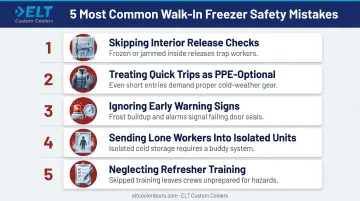
Even well-run operations fall into predictable patterns that build risk over time. Here are the five we see most often:
- Skipping interior release checks: A release mechanism can freeze or jam silently, and the first time anyone notices is exactly when someone needs it most.
- Treating quick trips as PPE-optional: Cold stress doesn't wait for a 20-minute inventory session; it can affect judgment and dexterity within minutes of unprotected exposure.
- Ignoring early warning signs: Frost creeping along a door seal, an alarm that's gone off twice this week, gaps in temperature logs — these are data points, not noise.
- Sending lone workers into isolated units: A remote walk-in with no check-in protocol turns routine stocking into an unsupervised risk, especially during off-hours shifts.
- Neglecting refresher training: New hires, equipment upgrades, and facility changes all shift what "normal" safety procedure looks like. Staff trained on last year's hardware may not recognize this year's release mechanism.
None of these require expensive fixes. They require consistency: someone actually doing the daily check, logging the entry, running the refresher session.
Conclusion
Walk-in freezer safety isn't complicated, but it does require three pieces working together: certified equipment, disciplined maintenance, and staff who actually know the procedures. Skip one of them, and the other two are just theater.
Treat safety checks and training refreshers as routine business practice, not an annual scramble before an inspection. That single habit prevents most of the incidents that end up in OSHA's accident database.
Equipment selection plays its part too. ELT Custom Coolers has spent over 18 years building NSF-approved, UL Certified, DOE-compliant walk-in cooler and freezer doors out of its Detroit, MI facility. Interior safety release hardware and heated frame options come built in from the start, not added on later. For operators planning a door replacement or new installation, that's one less variable to manage.
Frequently Asked Questions
How long is it safe to be in a walk-in freezer?
There's no universal maximum, but OSHA and NIOSH both recommend frequent breaks in warm areas rather than extended continuous exposure. Layer PPE properly and check in with a buddy every 15-20 minutes during extended stocking tasks.
What is the danger zone for a walk-in cooler?
The FDA Food Code defines the danger zone as 41°F to 135°F, the range where bacterial growth accelerates fastest. Walk-in coolers should stay at or below 41°F, with consistent monitoring to catch drift early.
What are the main safety risks in a walk-in freezer?
Key risks include entrapment from door release failure, cold stress and frostbite, slips from ice buildup, and mechanical failure during servicing. Controls vary by risk: hardware checks, PPE, floor maintenance, and lockout/tagout procedures.
Do walk-in freezers lock from the inside?
No, not legally. OSHA 1910.36 requires exit doors to open from inside without keys, tools, or special knowledge at all times. Code-compliant units include an interior safety release handle specifically for this reason.
What temperature should a walk-in freezer be for safety and food quality?
Most commercial freezers run between 0°F and -10°F to keep product solidly frozen. Temperatures drifting above that range often signal a failing door seal or a struggling compressor, not just a thermostat issue.
What should you do if you get locked in a walk-in freezer?
Locate the interior release latch immediately. Most units have it at door height with a glow-in-the-dark handle. Use a phone or alarm to call for help, and keep moving to maintain body heat while you wait.