
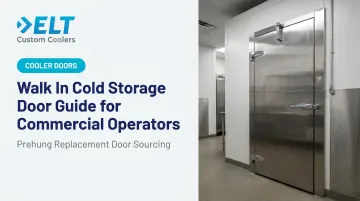
Worn seals let warm, humid air infiltrate the box, forcing the compressor to work harder and pushing interior temperatures into the danger zone. The USDA notes that refrigerated food must stay at 40°F or below to stay safe, a threshold a leaky door can blow past in minutes during a busy service.
This guide breaks down door types, materials, compliance standards, and a practical framework for choosing and maintaining a commercial walk-in door, so you can fix the problem instead of just patching it.
Key Takeaways
- Cooler and freezer doors need different insulation, gaskets, and heater-wire setups for their temperature gap
- Swing, sliding, strip curtain, and impact doors suit different traffic patterns and floor layouts
- NSF, UL, and DOE 2017 compliance are non-negotiable benchmarks for commercial-grade doors
- Custom-sized doors solve the retrofit problem when older openings don't match standard dimensions
Walk-In Coolers vs. Walk-In Freezers: Why Door Requirements Differ
Coolers and freezers aren't just the same box running at different settings. The temperature gap changes what a door has to physically withstand.
Temperature Differences That Drive Door Design
Coolers typically run in the 34-40°F range to hold perishables above freezing. Freezers run far colder, often -10 to 0°F, since the USDA specifies long-term frozen storage at 0°F or below. That 40-plus-degree swing between a freezer interior and a warm kitchen is what forces different door engineering altogether.
Insulation and Heater Wire Requirements
Federal design baselines require at least R-25 insulation for non-glazed cooler doors and R-32 for freezer doors, according to DOE energy conservation standards. ELT Custom Coolers reflects this general tiering in its own construction: standard cooler doors use R20 Formula 250 closed-cell insulation, while freezer and French freezer doors step up to an R32 PC20 rigid foam core for the added thermal load.
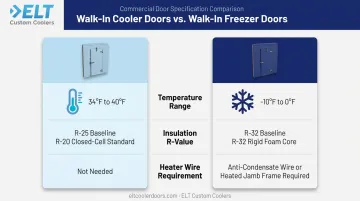
Freezer doors also need heat where coolers don't. Anything running below 32°F risks frost and ice forming around the frame, which can jam hinges and wreck the seal. That's why freezer-rated doors carry a heated perimeter, either as:
- A replaceable anti-condensate heat wire built into the door panel itself (used on swing-style replacement doors)
- A heated jamb sandwich frame, where the heating element lives in the frame assembly (used on sliding freezer doors)
Cooler doors skip this entirely since condensation freezing isn't a concern above 32°F.
Gasket and Seal Materials
Both door types typically pair a magnetic gasket with a double-sweep gasket for an airtight closure. The gasket compound and design have to hold up differently, though: freezer gaskets face sustained sub-zero flexing and frost cycling, while cooler gaskets deal with humidity and repeated warm-to-cold transitions.
Despite these differences, coolers and freezers share the same core door styles, swing, sliding, and strip curtain, which is where the real selection decisions happen.
Types of Walk-In Cold Storage Doors for Commercial Operations
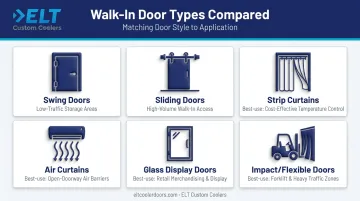
Picking a door style comes down to traffic volume, floor space, and how the opening gets used:
- Swing doors use a standard hinge-and-frame design and suit lower-traffic kitchens and back-of-house storage where there's room for the door to clear. They're the most common option for personnel-sized openings and the easiest to retrofit into existing frames.
- Sliding doors save floor space by moving along a track instead of swinging outward, making them a better fit for tight kitchen layouts or high-frequency access points like a walk-in staff pass through constantly during prep and service.
- Strip curtains (vinyl strip doors) hang inside the main door opening as a secondary barrier, cutting temperature loss during frequent openings. A Northwest regional efficiency study models the savings, but results depend heavily on door-open time and staff upkeep, so treat marketing figures with a grain of salt.
- Air curtains use a high-velocity stream of air across the opening to maintain a thermal barrier without a physical strip. Performance depends on discharge velocity and installation, and they work best paired with a hard door rather than replacing one.
- Glass display doors show off product in retail and merchandising settings but need extra engineering, insulated multi-pane glazing, low-e coatings, and sometimes heated frames to prevent fogging and heat gain.
- Flexible or impact doors handle warehouse and loading-area traffic where forklifts or carts pass through repeatedly. Rapid-closing panels reduce open time and absorb impacts that would destroy a rigid door.
Standard sizes cover most of these openings, but retrofits into older or oversized doorways typically call for a custom-built door and frame rather than a stock fit.
Must-Have Features, Materials & Industry Compliance Standards
A door that looks right on a spec sheet still has to perform under daily abuse. Four things separate a durable commercial door from one that fails within a year.
Insulation core. Polyurethane foam is the standard core material, and R-value matters more than raw thickness. Manufacturer assemblies vary from 4 to 6-inch panels rated anywhere from R-20 to R-32, so compare tested performance rather than assuming thicker automatically means better.
Frame construction. Aluminum resists corrosion through a natural oxide layer but can stain if moisture gets trapped. Galvanized steel relies on a zinc coating for cathodic protection and holds up well until that coating wears through. Neither is a universal winner, so let washdown chemistry and humidity levels guide the choice.
Sealing components. Magnetic gaskets, door sweeps, and threshold seals prevent air infiltration and moisture ingress. ELT's doors pair a magnetic gasket with a double-sweep gasket as standard across cooler and freezer models.
Hardware and safety. Heavy-duty, self-closing cam-lift hinges and commercial-grade handles are built for constant use. Every walk-in door also needs an interior safety release so staff can never get trapped inside, a feature ELT includes as standard, alongside NSF-approved chrome hardware.
Beyond these individual components, certifications separate marketing claims from verified performance:
| Certification | What It Covers |
|---|---|
| NSF | Sanitation and food-protection standards for materials and construction |
| UL | Electrical safety, critical for heated freezer doors and heater wire |
| DOE 2017 | Energy efficiency, insulation, and closer performance |
Reputable manufacturers, including ELT Custom Coolers, build every door to meet all three standards rather than treating them as optional upgrades.
How to Choose the Right Walk-In Door for Your Facility
Start with how your team actually uses the space, not just the opening size.
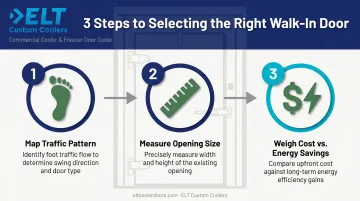
- Map your traffic pattern. Low-frequency back-of-house storage suits a swing door. High-frequency prep areas or tight kitchen footprints do better with sliding doors or a swing door assisted by strip curtains.
- Measure before you assume standard sizing. Older buildings and retrofit projects rarely match modern standard dimensions. ELT Custom Coolers manufactures custom cooler and freezer doors in-house for oversized, undersized, and older openings, with quotes turned around within one business day.
- Weigh upfront cost against lifetime energy savings. A cheaper door with weak insulation or a failing gasket wastes refrigeration capacity over time. Factor in local utility rates and expected door lifespan, and consider financing options like Affirm if upfront cost is holding back a needed replacement.
Installation & Maintenance Best Practices
Even a well-built door fails early if it's installed poorly. Professional installation matters: a hinge set a fraction off level or a frame that's not quite plumb causes ongoing energy loss that's easy to miss until the utility bill arrives.
Build a routine inspection habit rather than waiting for a breakdown:
- Check gaskets for tears, hardening, or gaps every couple of months
- Verify sweeps still brush the floor without binding or dragging
- Test heater wires and heated frames on freezer doors before peak season
- Confirm the door still self-closes and latches properly
Watch for these warning signs, and know when a repair is enough versus when replacement makes more sense:
- Visible frost buildup around the frame or threshold, usually a sign the heater wire has failed
- Condensation on the frame or nearby wall, pointing to a seal or insulation problem
- Fluctuating interior temperatures despite the refrigeration system running normally
- A door that won't stay latched or self-close, which compounds every other issue above
Minor gasket or hardware wear is usually a repair. A cracked panel, a failed heater wire embedded in the core, or a frame warped beyond adjustment typically points to door-only replacement instead. That's far less disruptive than replacing the entire walk-in box.
Frequently Asked Questions
Is a walk-in cooler the same as a walk-in freezer?
No. Both are enclosed cold storage spaces, but they operate at different temperature ranges. That difference drives separate insulation, gasket, and heater-wire specifications for the door.
What is the standard size of a walk-in cooler door?
Common commercial doors run roughly 30 to 60 inches wide and 78 to 96 inches tall, though ranges vary by manufacturer. Older buildings often need custom sizing to match non-standard openings.
How much does a walk-in freezer door cost?
Pricing depends on size, insulation thickness, heater wire, frame type, and finish. Prehung freezer replacement doors commonly start around $1,650 and scale up from there, so get a custom quote for your exact opening.
Can I replace just the door on my walk-in cooler without replacing the whole unit?
Yes. Door-only replacement is common and cost-effective when the panels and refrigeration system are still in good shape. Prehung doors with plug or jamb frames are built specifically for this kind of retrofit.
How do I know if my walk-in door needs heater wire?
Any door used in an application below 32°F typically needs heater wire or a heated frame to prevent frost and ice from jamming the seal. Standard coolers running above freezing don't need it.
What certifications should a commercial walk-in door have?
Confirm NSF approval for sanitation, UL certification for electrical safety on heated components, and DOE 2017 compliance for energy efficiency before buying any commercial walk-in door.